
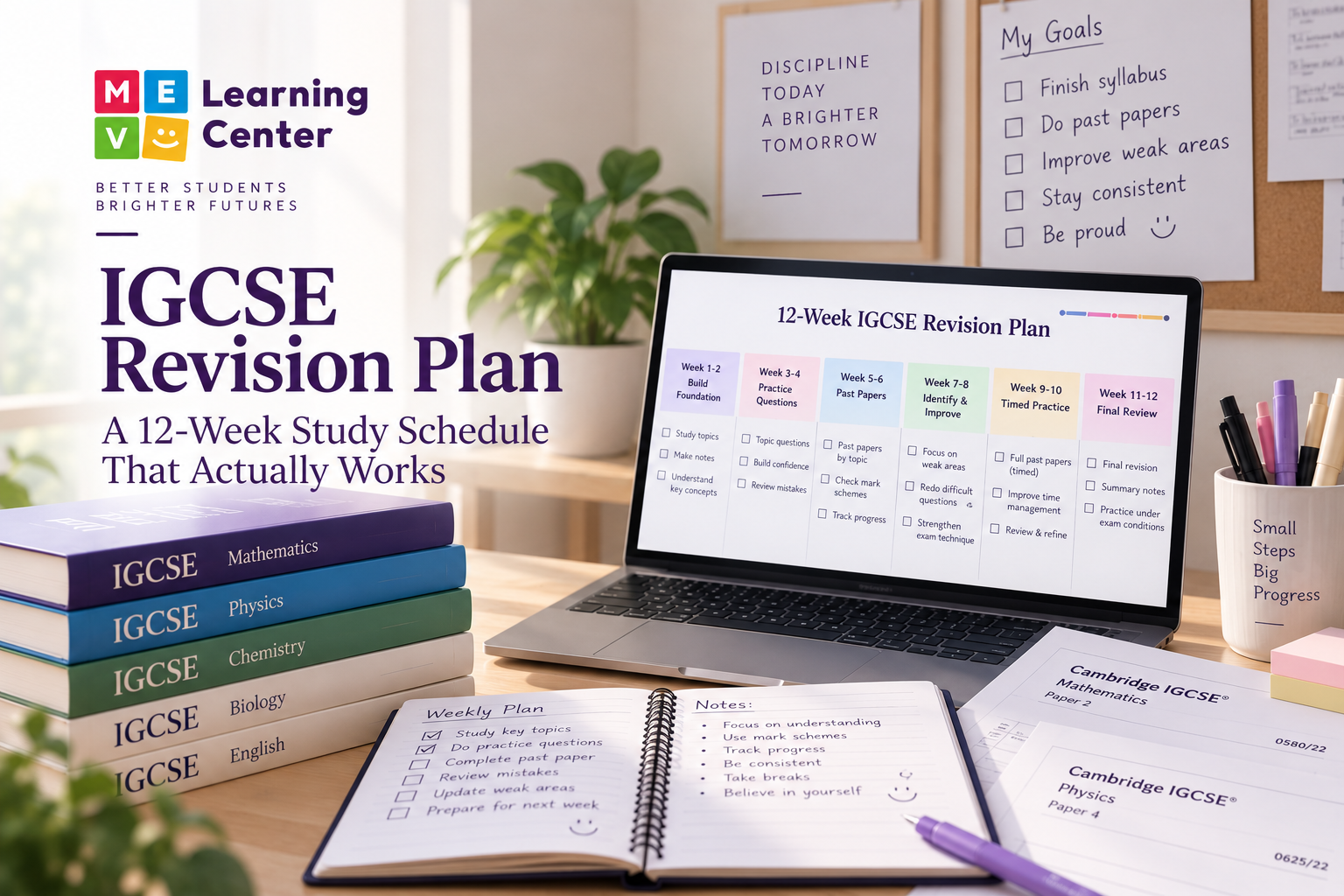
Most students do not fail IGCSE exams because they are not smart enough. They struggle because they start revising too late, revise passively or never practise under exam conditions.
This 12-week IGCSE revision plan fixes all three. It works for any subject and any exam board, and you can shorten or stretch it depending on your exam date.
Before you start: set up your system
Spend one hour on these before Week 1:
- Get the syllabus. Download the official syllabus for each subject from your exam board (Cambridge, Pearson Edexcel or other). It lists exactly what can be examined.
- Make a topic checklist. Turn every syllabus topic into a line on a checklist and rate it red, amber or green based on how confident you feel.
- Collect past papers and mark schemes. You will use these heavily from Week 5 onward.
- Block out your calendar. Add school, sports and family commitments first, then place study sessions around them.
The 12-week plan
Weeks 1 to 4: Rebuild and fill the gaps
Goal: cover every syllabus topic and find your weak areas.
- Work through the syllabus topic by topic, starting with the reds and ambers.
- Make short summary sheets, flashcards or mind maps for each topic. Keep them brief.
- Do a small set of practice questions after each topic to check understanding.
- If a topic still makes no sense after two attempts, ask your teacher or tutor. Do not keep rereading.
Weeks 5 to 8: Practise by topic
Goal: turn knowledge into exam marks.
- Do past paper questions topic by topic, using the mark scheme to mark your own work.
- Keep an error log: a page for each subject listing every mistake, why it happened and how to avoid it.
- Learn the command words (define, describe, explain, evaluate) and what each one demands.
- Revisit topics from Weeks 1 to 4 briefly every week. This is spaced repetition, and it stops early topics from fading.
Weeks 9 to 11: Full timed papers
Goal: build stamina, speed and exam technique.
- Sit one full past paper per subject each week under real conditions: timer on, phone away, no notes.
- Mark honestly using the mark scheme, then add every lost mark to your error log.
- Look at examiner reports where available. They explain exactly how students lose marks.
- Focus on your weakest paper types, such as extended writing or multi-step calculations.
Week 12: Sharpen and rest
Goal: arrive calm and prepared.
- Reread your error logs and summary sheets rather than learning new content.
- Redo a few questions you previously got wrong.
- Sleep properly, eat well and finish revising the night before at a reasonable time.
A simple weekly template
DaySessionMondaySubject A, 60 to 90 minutesTuesdaySubject B, 60 to 90 minutesWednesdaySubject C, 60 to 90 minutesThursdaySubject D, 60 to 90 minutesFridayWeakest subject, plus error log reviewSaturdayTimed past paper or long practice blockSundayRest, light review, plan the next week
Short sessions with breaks beat marathon sessions. Try 40 to 50 minutes of focused work, then a 10-minute break.
The four techniques that raise marks fastest
- Active recall. Close the book and write down or say what you remember. It feels harder than rereading, which is why it works better.
- Spaced repetition. Return to each topic after one day, one week and one month.
- Past papers with mark schemes. This teaches you what examiners reward.
- Teaching someone else. Explaining a topic aloud quickly shows you what you do not truly understand.
Subject-specific tips
- Mathematics: Practise until methods are automatic. Show all working, because method marks matter even when the final answer is wrong.
- Sciences: Learn definitions exactly, practise calculations and rehearse required practical questions.
- English: Read model answers, practise timed writing and learn to plan responses in five minutes.
Common revision mistakes
- Making beautiful notes but never testing yourself
- Avoiding past papers because the marks feel discouraging
- Studying favourite subjects and postponing difficult ones
- Cramming the night before
- Never asking for help until it is too late
When extra support helps
If your error log keeps showing the same topic, it is a sign that a gap needs to be fixed rather than repeated. Focused one-on-one sessions with an experienced tutor can help you close that gap quickly. At MEV Learning Center, tutors work with students on IGCSE subjects using clear goals and step-by-step guidance. Our guide to choosing an IGCSE online tutor explains what to look for.
Frequently asked questions
How many hours a day should I revise for IGCSE?
During the main revision period, most students do well with 2 to 3 focused hours on school days and a longer block at weekends. Quality matters more than hours, so track what you accomplish rather than how long you sit at your desk.
Is 12 weeks too long or too short?
Twelve weeks gives a comfortable rhythm for several subjects. With fewer weeks, shorten the content phase and protect the past paper phase. With more weeks, spend longer on Weeks 1 to 4.
Should I do past papers before I finish the syllabus?
Yes, but lightly. Try individual questions early to see the style, then move to full timed papers after you have covered most of the content.
How do I revise multiple subjects without burning out?
Rotate subjects across days, keep sessions short, schedule one full rest day and prioritise sleep.
Need help turning this plan into results? Talk to MEV Learning Center about one-on-one IGCSE support.